
Association of International Marathons and Distance Races
The home of world running™
Race news Prague International Marathon
12 May 2026, 1pm UTC
It took me one year and six hours to complete the Prague Marathon
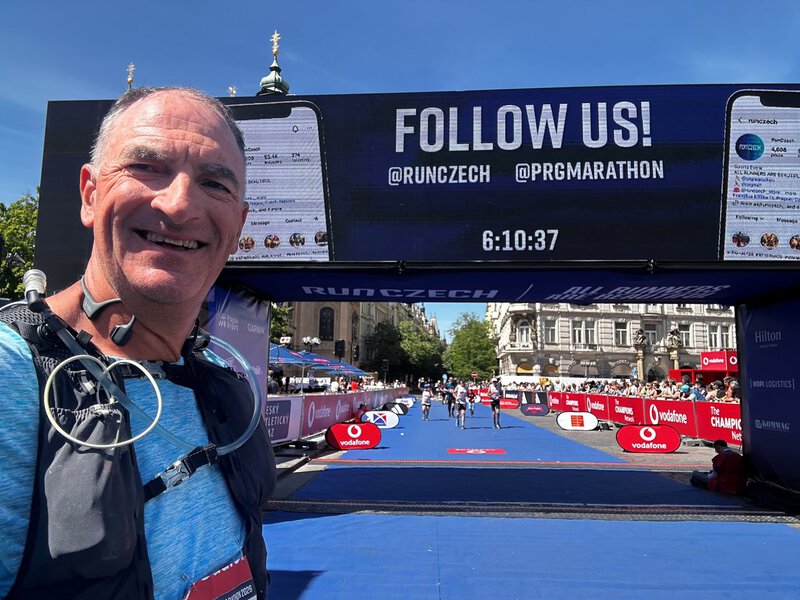
A year ago, his race ended just 800 meters after the start. Irish runner Paul McCann suffered a major cardiac arrest right on the course of the Prague Marathon.
Thanks to the immediate reaction of first responders and world-class medical care in Prague, he was given a second chance. This year, the 56-year-old runner returned to the Czech capital to finish what began as a tragedy. This is a story of resilience, gratitude, and a victory over fate.
In May 2025, news spread through the running world about an Irish competitor who had to be defibrillated eleven times during the Prague Marathon. Few believed such a person could ever return to the marathon distance. But Paul McCann did just that and this year he finished his way from hospital bed back to the blue carpet on Old Town Square.
Paul, could you take us back to the very start? When did you first discover your passion for running, and what was it that eventually led you to the marathon distance?
I never really considered myself a natural runner — I was never fast and probably even less so now after the heart attack. Originally, I was much more into cycling: road cycling and mountain biking. Ironically, it was actually a biking accident in 2016 that first pushed me toward running. I injured my leg in a fall, and the doctor suggested running as a way to rebuild fitness for cycling again.
What started as rehabilitation slowly became something much bigger. I discovered that running gave me many of the same things cycling did — freedom, fitness, and a sense of adventure — but with much less equipment. All you really need is a pair of running shoes and shorts, and you can take them anywhere in the world. I started running around my home city, often running to and from work because it was quicker than sitting in traffic. Without really planning it, the distances got longer and longer. Eventually, I decided to try a marathon.
Do you remember the day you ran your very first marathon? Where was it, and how did that experience shape you as a runner?
My first marathon was Madrid in 2018. My cousin from Ireland runs it regularly and invited me over, and I travelled there with friends from Poland who were doing the half marathon. The atmosphere was incredible. Madrid is not an easy course — it’s quite hilly — but I finished in 4 hours 15 minutes, and for a first marathon I was genuinely proud of that.
After that, there was no looking back. Over the following years I managed to complete a sub-four-hour marathon, and by the time I returned to Prague in 2025, aged 55, I had completed around 25 marathons in total. Running marathons had become a key part of my life. What I always loved most was not necessarily the finishing time, but the atmosphere itself — the joy of running alongside thousands of other like-minded people, all with their own stories, goals, and reasons for being there.
When did you first visit Prague, and what were your first impressions of the city?
My connection with Prague actually goes back much further than the marathon. I first visited in 2006 when a Czech colleague invited us for a weekend and showed us the city from a local perspective. I still remember how beautiful it felt that summer day, and how proud people were of their city. Over the years I came back many times, including for work conferences and vacation trips. I had run Prague first in 2022 and it was always one of the special races for me. I wanted to go back.
Last year, your race ended almost before it began. Looking back at that moment now, how has your perspective on life and sport changed since you were given this ‘second chance’?
Prague changed my life forever in 2025. During last year’s marathon, I suffered a major cardiac arrest. While my heart failed while running, in many ways, though, it was also running and sport that saved my life. The doctors explained afterwards that years of endurance training had helped my body and heart cope better during such a serious event. Without that, I probably would not be here today.
The journey from a hospital bed back to the marathon start line is incredible. What was the most challenging part of your physical and mental recovery during the past twelve months?
The recovery afterwards was not easy. In the first days after the heart attack, even walking felt difficult. Running again seemed impossible. But I took recovery one day at a time. The doctors, rehabilitation specialists, physiotherapists, nurses, paramedics, family, and friends all became part of that journey. I learned much more about my body than I ever understood before — not only about fitness, but also about fatigue, recovery, nutrition, hydration, and listening to warning signs.
There were good days and bad days, but thankfully the overall direction was always forward. Small improvements every week slowly built into bigger improvements. Some medications make training difficult and reduce performance, but over time I slowly regained confidence in my body again.
Did the events of last year change the way you train? Are you more cautious now, or do you find yourself ‘listening’ to your body and your heart in a different way than before?
Because of the heat this year, I prepared much more carefully than I ever did before. Hydration became extremely important, and I tapered training properly for nearly two weeks before the race to give my body the best chance possible. Most importantly, I listened to my body throughout the marathon. My plan from the beginning was to combine running and walking while keeping my heart rate under control.
The Sunday heat was brutal for many runners. How did you feel physically during the race, and how did the Prague crowds help you get through the tough sections?
In the end, it was actually my legs rather than my heart that gave up first around kilometre 33 or 34. Once I passed kilometre 30, I knew I would reach the finish somehow, and I decided not to push my luck. This was always going to be my final full marathon, and I wanted to enjoy every remaining step. Of course, I still ran across the finish line.
Crossing the finish line is a great moment for everyone. For you, it was a victory itself. Can you describe the emotions you felt the moment you saw your finish time?
Emotionally, it felt like it had taken me one year and six hours to complete the Prague Marathon — because in many ways, the marathon started for me back in May 2025. What happened afterwards last year was only survivable because of an extraordinary chain of people, preparation, and teamwork. The response from everyone involved was incredibly fast and professional.
At the hospital in Prague, I was fortunate once again. The doctors, nurses, specialists, physiotherapists, and intensive care teams did an extraordinary job — not only saving my life, but helping me recover in a way that allowed me to return to a proper quality of life afterwards. That is why coming back to Prague this year meant so much to me emotionally. The marathon organisation, volunteers, paramedics, doctors, nurses, and hospital staff all became part of my recovery story.
Your story is an inspiration to many other people. What would you say to someone who is currently facing a major health setback or is afraid to return to the sport they love?
A lot of people hear “cardiac arrest” and assume that is the end of the story. In my case, I was given a second chance at life. What I would say is this: recovery happens one day at a time. Not every day is easy, but small improvements add up. And never underestimate the importance of the people around you — family, friends, medical teams, and even strangers — because their support can make an enormous difference.
This marathon was my way of honouring that — and also of showing what is possible when modern medicine, advanced equipment, and the skill and dedication of the Prague medical professionals all come together.
Partners

Sports Partner

Photo Partner

Registration Partner

Medals Partner
For further information on our partners, click on the logos above.
Distance Running
Official quarterly magazine of AIMS
Latest issue:
2026 Edition 2
Cover: Midnight Sun Marathon, Norway
Keep up to date!
For the latest race dates please consult the official online AIMS calendar.
You can also subscribe to the AIMS calendar in your calendaring application of choice, whether on your phone, tablet or computer. Simply subscribe to webcal://aims-worldrunning.org/events.ics in your calendar app.
AIMS
the home of world running™